
WHAT IS A MOTION?
A motion is a proposal from Members, asking the Institute to consider a specific issue at an AGM.
Once received, Council may act on any motion in different ways. It may be reasonable to address the motion through “business as usual” activity, including discussion forums, existing policy, procedural updates or position statements.
Council may decide it is reasonable for the proposer to table the motion for consideration at the AGM, where Members vote on its content.
Every motion submitted will be considered seriously by Council in accordance with its obligations and if Council declines to include a motion in the AGM agenda, it will explain its reasoning.
PROPOSING A MOTION
Before a Member drafts a motion
Where time allows, Members are asked to contact the Institute office to check whether the Institute is already actively working on the subject matter of the proposed motion. This helps to avoid proposing a motion on an issue that the Institute is already working on. It also enables the Member to find out whether there have already been motions on the issue in the recent past and what action was taken in that regard.
Members might also consider whether a motion is the most appropriate way to raise an issue. In many circumstances, it may be more effective to raise an issue directly through one of the other channels available
Who can submit a motion?
A motion can be put forward by any Institute Member (as defined within the memorandum and articles of association), provided it is seconded by another Institute Member.
Drafting a motion
A motion should:
- Be in the best interests of the Institute.
- Be achievable taking into consideration the nature of the Institute, the terms of its memorandum and articles of association and the resources available to it.
- Use clear, concise, specific, accurate and unambiguous language.
- Articulate clearly and specifically what the membership is being asked to consider.
- Clearly and unambiguously identify the action required and any relevant timeframe.
- Stand alone. One motion cannot be dependent upon another motion.
- Avoid personal, offensive or potentially libellous language.
Submitting a motion
A motion must be made in writing and can be submitted to the office at any time. To be considered for any specific AGM, it must be received by the Institute at least two clear months before that AGM. This means it needs to be submitted by 23.59 on the date two clear calendar months before the AGM, regardless of the time of the meeting.
You can submit a motion using this online form.
Review and acceptance of motions
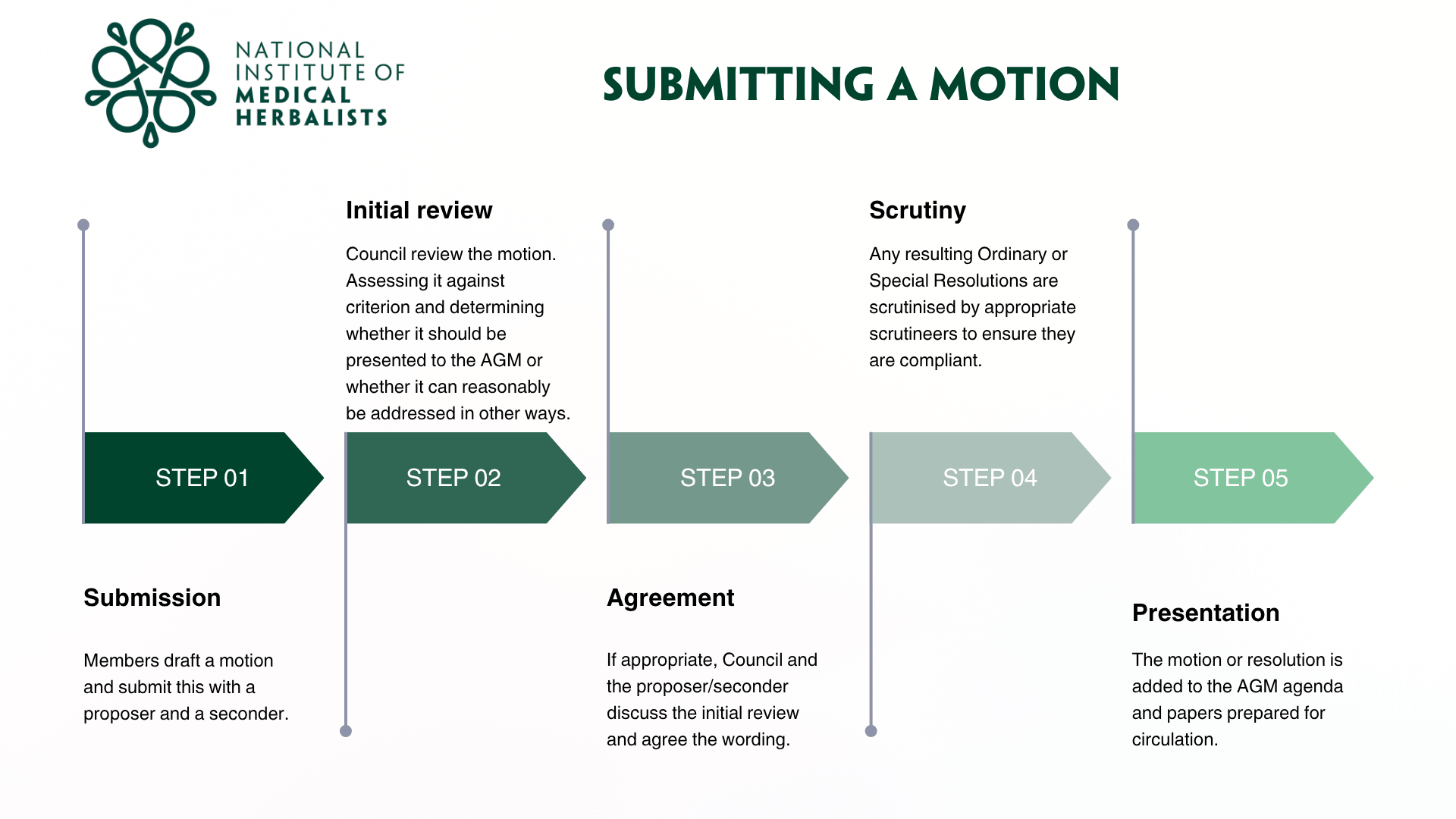
All proposed motions are reviewed by Council. Where needed, Council will work with the proposers to produce a clear, concise motion capable of membership consideration in the timescale available at the AGM and that is sufficiently clear to be actionable.
Council shall in good faith and in accordance with its obligations:
Decide whether the motion should be placed on the AGM agenda
If Council considers that the motion reasonably warrants presentation to the membership at an AGM, it shall decide whether it should be put:
- As an ordinary resolution, where a simple majority (more than 50 % of votes cast by Members present (in person or by proxy)) is required for it to be passed and, if passed, it is binding upon Council; or
- As a special resolution, where at least 75 % of votes cast by Members present (in person or by proxy) is required for it to be passed and, if passed, it shall be binding on Council, or
- As an advisory motion, where the outcome of the vote is not binding, but will be taken into account by Council in its subsequent decision-making.
Decide an alternative route where the motion is not suitable for the AGM
If Council considers that a motion does not reasonably warrant presentation at an AGM, it shall:
- Decline to include it on the AGM agenda;
- Provide the proposers with a brief written explanation of the reasons why it does not meet the criteria for AGM business; and
- Where appropriate, indicate a more suitable route for addressing the issue raised (for example, discussion forums, existing policy, procedural updates or position statements).
Proposers whose motions reach the AGM agenda will be allocated a timeslot in which to formally propose and speak to their motion.
Members always have the right, following a written request of at least 5 % of Members to require business to be put before the membership at a General Meeting (article 21).
How the motion is handled
In the AGM papers provided to members in advance of the AGM, the Council may, itself, prepare a statement commenting on any motion proposed. This statement, may include a recommendation to Members as to how Council recommends they should vote and its reasoning as to why.
At the AGM
It is recommended that the proposer and/or seconder of a motion on the AGM agenda attends the AGM to present it to the meeting. If the proposer cannot or does not wish to present it, they may nominate another voting member in attendance to speak on their behalf. Those presenting a motion should be aware that it will have already been circulated to all members, along with a response from Council, and there is therefore no need to cover anything set out in the papers.
Proposers will have the opportunity to contribute information they feel is pertinent to help the membership understand their position, or to address the Council response. Council may then choose to respond further. It is requested that no speaker spends more than three minutes presenting on any item of business to ensure the whole agenda can be covered.
After the presentation of a motion, members will be given an opportunity to put questions to the proposer and to Council. Such exchanges should be conducted civilly, professionally and in a constructive spirit.